

20 Mar Strategy of Marketing: How to Build a Digital-First Approach That Drives Growth
Key Takeaways
- A strategy of marketing is your long-term blueprint for attracting, converting, and retaining customers—distinct from day-to-day tactics like ad campaigns or social posts that change weekly.
- Modern marketing strategy must be digital-first and integrated across channels, as 85-90% of customer journeys now begin online.
- Data, measurement, and continuous optimisation are non-negotiable pillars; without them, you’re guessing instead of growing.
- This article provides step-by-step guidance, practical frameworks (RACE, AIDA, journey mapping), and a real-world eCommerce example you can adapt.
- A documented, clear marketing strategy improves cross-functional alignment and delivers 20% higher ROI on marketing spend compared to ad-hoc efforts.
Introduction: Why the Strategy of Marketing Must Be Digital-First in 2026
The strategy of marketing is the high-level blueprint for how a business attracts, converts, and retains customers. It answers fundamental questions: who you serve, what makes you different, and which channels will drive growth.
In 2026, the shift from campaign-centric, traditional marketing to always-on, digital-first strategies is complete. Privacy regulations, the deprecation of third-party cookies, and AI-powered discovery tools have fundamentally changed how potential customers find and evaluate products. Search engines process 8.5 billion queries daily. Social platforms reach 5.2 billion users. Email remains a powerhouse with 40x ROI on automated flows.
This article covers what a marketing strategy actually is, why digital channels dominate, the core components of an effective marketing strategy, proven frameworks, a step-by-step marketing planning process, common mistakes to avoid, and a real-world example of a mid-sized eCommerce brand that grew revenue by 30%.
What Is a Marketing Strategy?
A marketing strategy defines who you target, what you offer, and how you will win against competitors. It is your long-term, customer-centric blueprint aligned to business goals like revenue growth, market share expansion, or improved profitability.
The distinction between strategy and tactics matters. Strategy sets direction—your positioning, target audience segments, and channel prioritisation—and remains stable over 12-24 months. Marketing tactics are the specific actions: running a particular advertising campaign, testing email subject lines, or launching a social media campaign. Tactics change weekly based on performance data.
A quick clarification of related terms: your business strategy defines overall company aims; your marketing strategy outlines how marketing supports those aims; your marketing plan documents the timeline, budget, and specific marketing activities; and individual campaigns are the executable marketing initiatives.
Data and customer insight form the foundation of any effective marketing strategy. Market research (including surveys and focus groups), first-party customer data from your CRM, analytics tools like Google Analytics, and direct customer interviews inform every strategic decision. Companies using this approach reduce customer acquisition cost by up to 25%.
A documented strategy of marketing clarifies priorities across teams, prevents scattered marketing efforts, and aligns sales, product, and finance around shared marketing goals. Research shows firms with written marketing plans achieve 20% higher ROI on overall marketing efforts.
Why Digital Is Central to Modern Marketing Strategy
In 2026, most customer journeys start, research, and often conclude online. This reality makes digital marketing strategy the core of any strategy of marketing, regardless of industry.
Digital channels collectively cover every stage from discovery to purchase:
Search (SEO and paid advertising): Google handles 92% of searches globally. Search engine optimisation drives 53% of website traffic on average and delivers 12x ROI compared to paid channels. Paid search captures high-intent traffic from potential customers actively looking for your product or service, and many brands partner with specialised Google Ads management services in Australia to maximise ROI from this channel.
Social media: LinkedIn generates 80% of B2B leads with conversion rates 2-3x higher for decision-makers. For D2C brands, TikTok and Instagram dominate visual discovery, with user-generated content boosting conversions by 29%. Your choice of social media channels depends entirely on where your target customers spend time.
Email and CRM: Email marketing remains critical for nurturing leads and driving customer retention, especially as first-party data becomes more valuable. Personalised email sequences achieve 21-25% open rates versus 1-2% for cold outreach. This channel directly supports your ability to retain customers and build brand loyalty.
Content marketing: Articles, guides, webinars, and videos act as the fuel feeding all digital channels. Long-form content ranks in search engine results and AI-powered discovery tools like Perplexity and ChatGPT. Short-form video sees 2.5x higher customer engagement rates.
The defining advantage of digital is measurability. You can run A/B tests, analyse cohorts, model attribution, and shift budgets in real-time. This capability turns your marketing budget into an optimisation engine rather than spending money on hope.
A modern integrated marketing strategy still respects offline touchpoints: events, print advertising and TV ads, but orchestrates them around a digital spine where every interaction can be tracked and improved.

Core Components of a Digital Marketing Strategy
This section breaks the strategy of marketing into six practical building blocks. Each component feeds into the step-by-step process covered later. Whether you’re building an eCommerce, SaaS, or service-based digital marketing strategy, these elements apply.
Audience & Segmentation
Segmentation means splitting your target market into groups by needs, behaviour, and value. In B2B contexts, this includes differentiating between marketing-qualified and sales-qualified prospects within your broader B2B lead generation strategy. The Pareto principle often applies: 80% of revenue comes from specific high-value segments.
Practical methods for segmentation include:
- Analysing CRM data to identify high-LTV customer patterns
- Interviewing ideal customers about pain points and decision criteria
- Reviewing GA4 and ad platform insights (60% of B2B buyers are mobile-first)
- Building 2-4 actionable personas
An example persona: “Operations-focused SME owner, UK-based, 35-50, prioritises ROI over features, seeks 30% efficiency gains.” This level of specificity directly informs your marketing channels, messaging, and offers.
Value Proposition & Positioning
Your value proposition is a concise promise of value: who you help, what outcome you deliver, and how you’re different. A simple formula:
“We help [target audience] achieve [specific outcome] unlike [competitors] by [unique method].”
For example: “We help SMEs cut operational costs 25% faster than legacy tools via AI automation.”
Positioning defines how you want to be perceived relative to key competitors—premium versus affordable, data-driven versus intuitive, fastest implementation in the market. This unique value proposition must appear consistently across website copy, ad headlines, email subject lines, and your broader marketing message.
Channel Strategy
Channel strategy determines which distribution channels to use, each channel’s role, and how they work together in an integrated marketing strategy.
Map channels to funnel stages:
- SEO and paid search for high-intent capture (bottom funnel)
- Paid social for awareness (top funnel)
- Email for nurturing and converting consumers (mid/bottom funnel)
- Content marketing for education across stages
Budget allocation, target audience behaviour, and sales cycle length shape prioritisation. Example mixes:
| Business Type | Core Channels | Typical Split |
|---|---|---|
| B2B SaaS | LinkedIn Ads, SEO, Email | 40% LinkedIn, 30% SEO, 20% Email, 10% Test |
| D2C eCommerce | Meta/TikTok, SEO, Email/SMS | 35% Social, 30% SEO, 25% Email, 10% Test |
Content Strategy
Content strategy plans what to say, to whom, in which formats, and at which journey stages, including how you will convert blog readers into loyal customers through high-intent content and nurturing flows.
Map content to funnel stages:
- Top-of-funnel: Educational blog posts driving organic traffic (3x traffic lift)
- Mid-funnel: Comparison guides and webinars (50% more leads)
- Bottom-funnel: Case studies and demos (20% demo bookings)
Formats suited to 2026 include webinars (15-20% conversion rates), short-form video, interactive tools, and long-form SEO articles optimised for AI visibility. Repurposing a single webinar into blog posts, social clips, and email sequences delivers 3-5x ROI amplification, especially when you apply proven content marketing and social media tactics to increase engagement.
Data, Tracking & Attribution
A solid data foundation underpins any serious strategy of marketing in a privacy-conscious environment.
Set up analytics tools (GA4), tag managers, CRM integrations, and pixels to track key events: leads, trials, purchases, and lifetime value. Server-side tagging captures 60% more signals than client-side alone.
Attribution approaches include:
- Last-click (simple but misleading)
- Data-driven attribution (more accurate, 25% better channel credit)
- Media mix modelling (reveals cross-channel interactions)
Use attribution directionally, not dogmatically. With cookie deprecation accelerating, build a first-party data strategy with proper consent management to preserve 70-80% of your measurement signals.
Budget Allocation & Forecasting
Budget allocation matches investment to expected impact, not evenly spreading spend across marketing channels.
Start with revenue targets and work backwards using historical CPA, ROAS, or benchmark data. Example for a $500k annual marketing budget targeting 25% revenue growth:
| Channel | Allocation | Expected ROAS |
|---|---|---|
| Search (SEO + PPC) | $175k (35%) | 5x |
| Paid Social | $125k (25%) | 3x |
| Retention/Email | $100k (20%) | LTV uplift 40% |
| Content & Experiments | $100k (20%) | Variable |
| Reserve 10-20% for experimentation with new digital channels or creative angles. These tests often yield 15-30% efficiency gains. |
Proven Marketing Strategy Frameworks (Digital Context)
Frameworks structure thinking, align teams, and prevent gaps in your strategy of marketing. Three widely used frameworks adapt well to digital marketing strategy: RACE, AIDA, and customer journey mapping.
RACE Framework (Reach, Act, Convert, Engage)
RACE maps the customer lifecycle to digital interactions:
- Reach: Drive awareness via SEO, PPC, and social (measure: sessions, impressions)
- Act: Encourage engagement on-site (measure: time on page, micro-conversions)
- Convert: Capture leads or sales (measure: conversion rate, revenue)
- Engage: Retain and grow relationships via email and loyalty programs (measure: retention rate, LTV)
Use RACE to audit current activity: identify which stages are underinvested. One eCommerce firm shifted 10% of its acquisition budget to engagement programmes and increased customer lifetime value by 18%.
AIDA for Digital Funnels
AIDA (Attention, Interest, Desire, Action) structures creative and landing page flow:
- Attention: Thumb-stopping social ads or headlines (target 1-2% CTR)
- Interest: Problem-focused content that speaks to pain points
- Desire: Social proof, testimonials, and case studies, building trust
- Action: Clear CTAs driving conversion (increase sales by 15%)
AIDA aligns copywriters, designers, and media buyers around one funnel logic. A landing page following AIDA structure typically lifts performance 20-40%.
Full-Funnel & Customer Journey Mapping
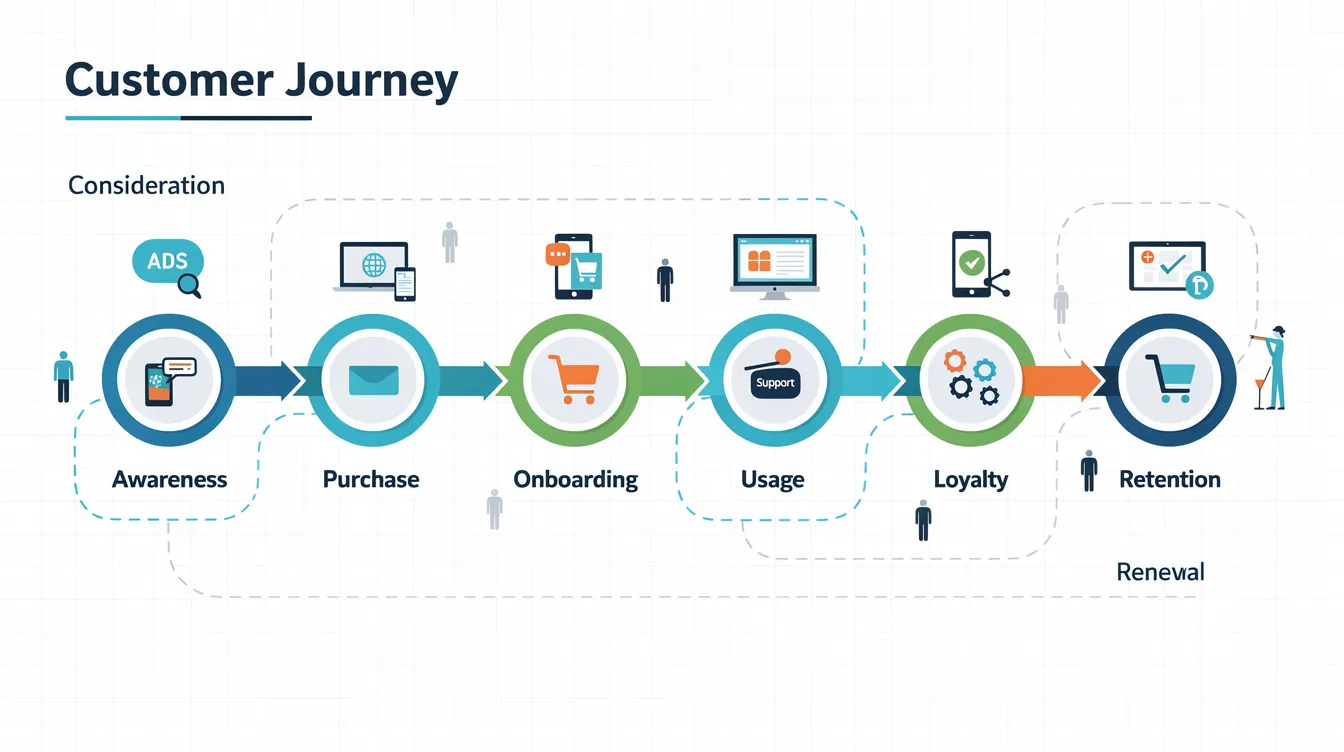
Customer journey mapping visualises every step from first touch to repeat purchase and advocacy.
Typical stages: Aware → Consider → Evaluate → Decide → Onboard → Retain
Benefits include spotting gaps (no mid-funnel content causing 40% drop-off), identifying friction points, and aligning channels to stages. For B2B, map how multiple stakeholders interact with different touchpoints over 3-6 months—LinkedIn nurtures influencers while email closes decision-makers.
How to Build a Digital Marketing Strategy (Step-by-Step)
This section provides a practical marketing planning process that turns the strategy of marketing into an executable roadmap.
1. Define Business and Marketing Goals
Convert high-level business goals into specific marketing objectives using the SMART framework:
- Business goal: “Grow revenue by 25% in FY 2026”
- Marketing objectives: Generate 500 qualified leads monthly, reduce customer acquisition cost by 15%, and achieve $2M pipeline contribution
Align with finance and sales so marketing goals connect to revenue targets and are traceable through key performance indicators.
2. Conduct Market and Competitor Analysis
Review market size, growth trends, and buyer behaviour using industry reports, search data, and customer interviews. Identify 3-5 key competitors and analyse their positioning, channels, messaging, and content strengths.
Tools for competitor analysis:
- SERP analysis for SEO positioning
- Social ad libraries (Meta, LinkedIn) for creative approaches
- Review platforms for customer feedback and competitive advantage gaps
3. Identify and Prioritise Target Audiences
Segment your market, then prioritise 1-3 core segments based on strategic value and ease of acquisition. Document each priority segment with demographics, firmographics (for B2B), decision triggers, and objections.
This step directly shapes messaging, offers, and channel selection. Focus on the right customers rather than all new customers.
4. Clarify Value Proposition and Messaging
Turn your value proposition into 2-3 core messaging pillars tailored to each priority audience. Create a simple messaging hierarchy:
- Brand narrative (what you stand for)
- Key proof points (quantifiable metrics and results)
- Specific product/service messages (outcome-focused, not feature-focused)
Rephrase technical benefits into outcomes: “AI-powered automation” becomes “Cut operations costs 25% in 90 days.”
5. Select and Prioritise Digital Channels
Choose channels based on audience habits, funnel coverage, historical performance, and cost per outcome. Categorise into:
- Core: Channels driving primary acquisition (SEO + PPC)
- Support: Channels enhancing core efforts (LinkedIn Ads, email)
- Experiment: Test channels with limited budget (TikTok, podcasts)
6. Create a Content and Campaign Plan
Build a 3-6 month content calendar aligned with product launches, seasonality, and journey stages. Map key marketing campaign efforts to business milestones with clear objectives per campaign.
Maximise ROI through repurposing: webinar → blog post → social clips → email series. One piece of content feeds multiple channels.
7. Set KPIs, Tracking, and Targets
Select a small set of primary KPIs per channel and funnel stage:
- Qualified leads and MQL-to-SQL rate
- ROAS and blended CPA
- Churn rate and customer satisfaction scores
Set quarterly targets and build a reporting cadence: weekly dashboard reviews, monthly performance meetings. Ensure consistent definitions across the organisation.
8. Launch, Test, and Optimise
Launch with a minimum viable mix rather than attempting every initiative at once. Run a test-and-learn loop:
- Form hypotheses based on data
- Run A/B tests (typically 20-30% uplift potential)
- Review results weekly
- Scale winners, cut poor performers
Optimisation levers include creative, audiences, bids, landing pages, email subject lines, and funnel steps.
Common Mistakes in Marketing Strategy
Many teams confuse busyness with strategy. Avoid these expensive missteps:
Confusing channels with strategy: Running “some Google Ads and posting on social” without clear brand positioning, target audience definition, or marketing goals wastes 30-50% of spend. Fix by documenting positioning before touching any channel.
Lack of clear KPIs: Launching campaigns without agreed success metrics makes optimisation subjective. Every marketing initiative needs quantifiable metrics tied to business success.
Over-reliance on one channel: Depending on a single source (e.g., Meta Ads) creates vulnerability to algorithm or policy changes. Diversify to protect against 40% traffic loss scenarios.
No integration across channels: Fragmented messaging and disconnected data lead to poor customer experiences. An integrated marketing strategy requires a consistent brand voice and shared tracking.
Ignoring data and attribution: Making decisions based on gut feel or vanity metrics wastes resources. Use your analytics tools for every budget decision.
Underinvesting in retention: Focusing only on new customers while neglecting onboarding, upsell, and win-back programmes ignores 60-70% of lifetime value. Loyal customers cost less to retain customers than to attract customers.
Real-World Example: Digital-First Strategy for a Mid-Sized eCommerce Brand
Consider a mid-sized fashion eCommerce brand in the UK targeting 30% online revenue growth over 12 months.
Initial situation: Heavy reliance on paid social (ROAS 2.5x), weak email programme, minimal SEO presence, and limited attribution visibility. Most of the marketing budget went to Meta Ads with diminishing returns.
Strategic process applied: The team clarified positioning around sustainable, mid-priced essentials for young professionals. They identified two priority segments: university students and early-career professionals in competitive markets. Core channels selected: SEO, Meta Ads, TikTok, and email.
Concrete strategic moves:
- Invested in an evergreen content hub for search engine optimisation (50+ articles targeting long-tail queries)
- Launched a UGC-driven social media campaign featuring real customers
- Built lifecycle email flows: welcome series, browse abandonment, post-purchase nurturing
- Implemented server-side tracking and data-driven attribution
Results after 12 months:
- Organic traffic up 40%
- Blended ROAS improved 25%
- Email is driving 22% of monthly revenue
- Customer retention increased through loyalty programs
The gains came from a coherent, integrated marketing strategy—not a single “silver bullet” tactic. Local businesses and larger enterprises alike can replicate this approach by following the same process, and smaller organisations may benefit from partnering with a small business marketing company to execute an integrated digital plan.

Conclusion: Turn Your Strategy of Marketing into a Living System
A documented, digital-first strategy of marketing separates growing businesses from those spending money without direction. In 2026, the marketing landscape demands clarity: who you serve, how you’re different, and which digital channels you will prioritise.
Effective strategies are living systems. Review your comprehensive plan monthly or quarterly, informed by performance data and customer feedback. Markets shift, competitors adapt, and new market opportunities emerge. Your strategy should evolve while your core positioning remains stable.
Start by auditing your current strategy against the six components outlined above. Gaps become obvious quickly—whether in tracking, customer retention, or inbound marketing programmes. Consider expert support or internal workshops to accelerate progress and build business marketing strategy capabilities within your team, especially if you need help designing a tailored digital marketing strategy for your brand.
[Insert link to digital strategy consulting page]
FAQ: Strategy of Marketing in a Digital-First World
These questions address practical implementation issues beyond what the main article covers.
How often should I review and update my marketing strategy?
A full strategic review is typically done annually, aligned with business planning cycles. Lighter quarterly check-ins should evaluate channel mix and budget allocation based on performance data. Fast-moving environments like D2C or startups may need monthly reviews of specific channels while keeping core positioning stable for 12+ months.
What budget percentage should I allocate to marketing in a growing business?
Typical benchmarks range from 5-10% of revenue for established firms to 10-20% for high-growth or venture-backed companies, varying significantly by industry. Start from revenue targets and work backwards using realistic acquisition and retention metrics. Always reserve a portion for testing new channels or formats before scaling spend.
How do I choose between brand marketing and performance marketing?
Strong marketing strategies balance both. Brand marketing builds demand over time through awareness and trust; performance marketing captures and measures existing demand now. Early-stage or cash-constrained businesses often lean 60-70% toward performance marketing while dedicating smaller shares to brand. Longer, competitive sales cycles typically require more brand investment to create a competitive advantage.
Do small businesses really need a formal marketing strategy document?
Yes—even small teams benefit from a concise written strategy of marketing (2-3 pages). A lightweight document covering business goals, target audience, positioning, key channels, and KPIs provides focus that prevents scattered marketing activities. Clarity and alignment matter more than document length or complexity.
Which digital channel should I prioritise first if I’m starting from scratch?
Choose based on audience intent and time horizon. Paid search and paid advertising can drive faster results with immediate visibility. SEO and content marketing compound over time but require patience. The recommended approach: start with one core acquisition channel plus a strong email or CRM foundation for nurturing. Run quick experiments with limited budgets to validate assumptions before committing heavily to any single channel.
Sorry, the comment form is closed at this time.